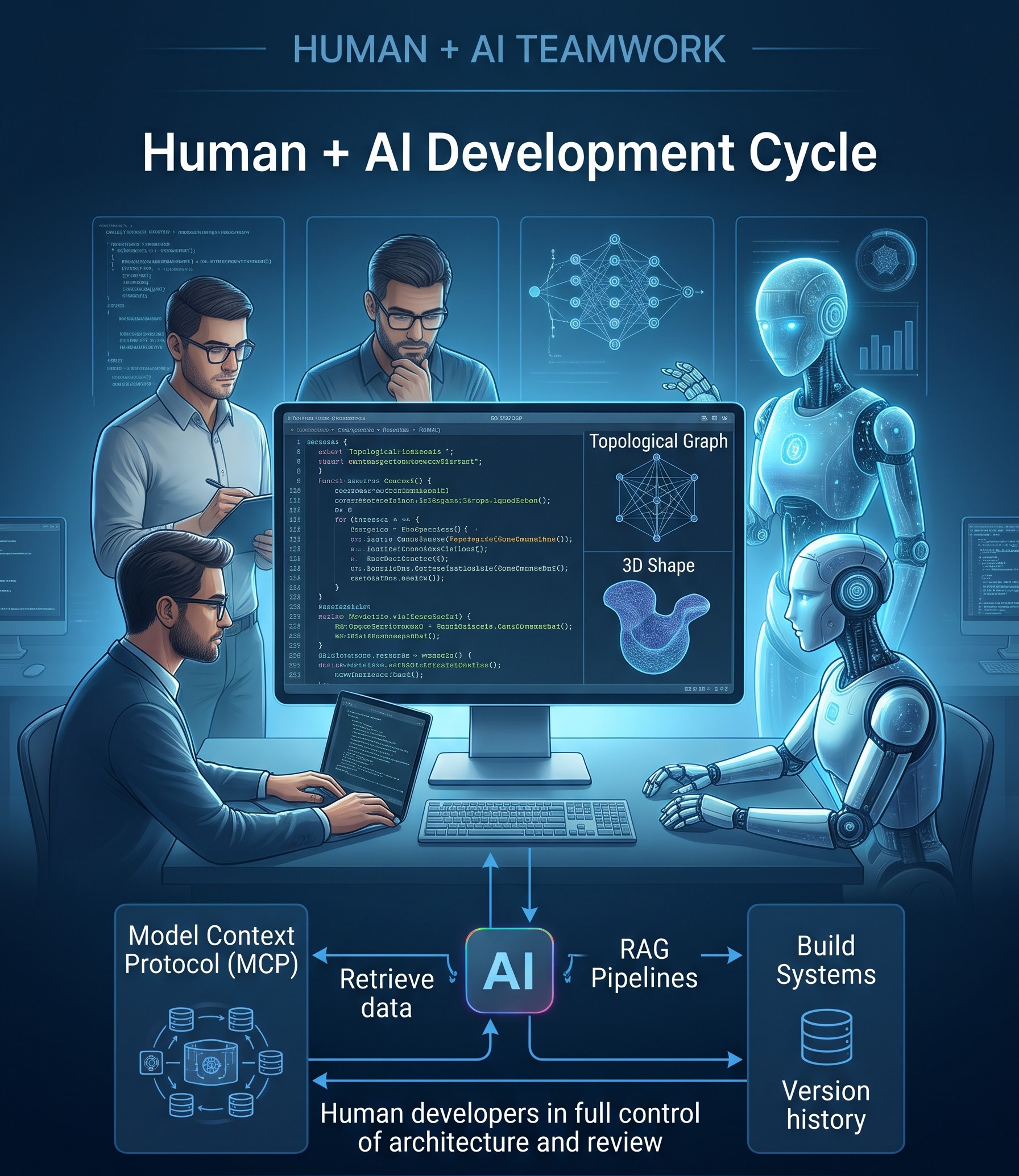
Human + AI Development Cycle
Engineering Software Development: Human Guidance and Control and AI Acceleration
Local & Frontier LLMs and Domain ML
- The leading LLMs for the best performance (Claude, GPT, Gemini) and private local inference (Qwen, gpt-oss, Gemma) for protected data
- AI-generated code is double-reviewed by our developers and by multi-LLM code review frameworks, and thoroughly tested
- Multi-agentic systems on the basis of MCP, RAG pipelines and LLM fine-tuning
- Deep learning networks for point cloud and polygonal mesh recognition integrated into general 3D and digital medicine pipelines
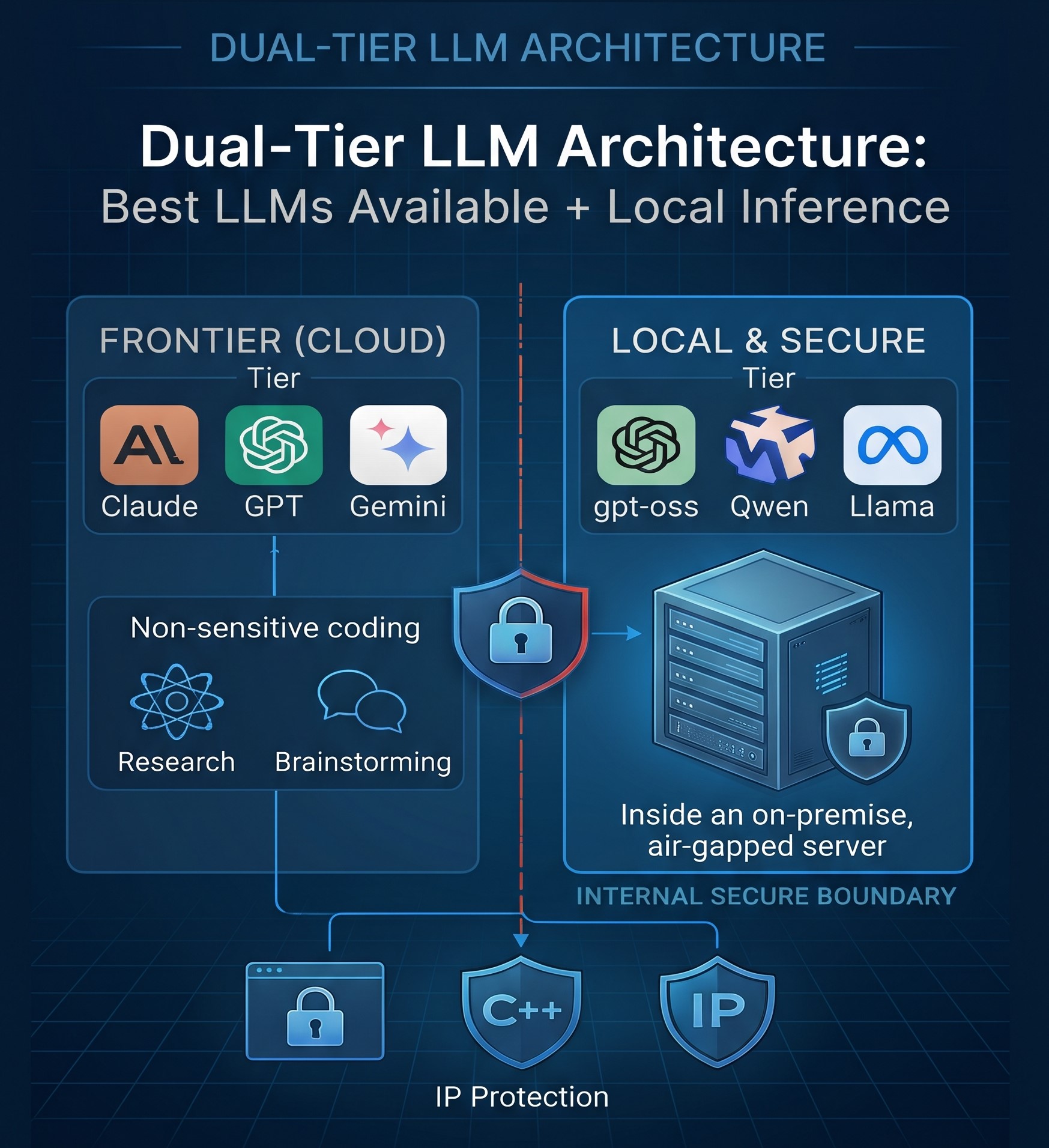
Dual-Tier LLM Architecture: Best LLMs Available + Local Inference
In most production engineering software codebases client’s IP (intellectual property rights) cannot leave controlled boundaries. Rather than choosing between AI prohibition and IP exposure, LEDAS wisely combines the power of AI and data/code protection.
For brainstorming, research, architectural solutions, and non-proprietary algorithmic prototyping, we utilize frontier reasoning / coding models (Anthropic Claude, OpenAI GPT, and Google Gemini). We use these models for general software development, bugfixing and quality assurance as well, subject to confirmation by a customer.
For NDA-restricted information, our engineers run quantized and full-precision open-weights models including gpt-oss, Qwen / Qwen-Coder, DeepSeek-R1 / V3, and Llama via local inference frameworks.
Our Leading Developers Harness AI Capabilities
Generic coding assistants may fail on mature C++ geometric codebases because naive text chunking severs large class hierarchies, complicated coding contracts, and topological invariants (such as Euler-Poincaré formulas and half-edge manifold conditions). Human expertise and control are still crucial for heavy codebases of 3D modeling and engineering software.
We combine our 25 years of experience in CAD / CAM / BIM and overall engineering software with the research capabilities of our 10+ PhD experts and frontier AI performance. Real productivity comes not from isolated prompts but from structured teamwork between specialized AI agents and experienced engineers.
At LEDAS, we build “Human + AI” workflows where our employees mostly handle planning, architecture, code review, and the most challenging development work, while AI provides more basic code generation, an additional code review layer, and most of the automated testing. In some projects, we establish more automated development cycle by building a multi-agent environment using the Model Context Protocol (MCP). These multi-agent environments may connect directly to our build systems, documentation, and version history (these accesses are always discussed and confirmed by the customer). When needed, we develop RAG pipelines for retrieving 3D and 2D models and overall CAD data, relevant code examples, documentation on 3D kernels and other third-party libraries. In some cases our development teams also fine-tune open-weights LLMs on curated internal project data, significantly improving accuracy across 3D modeling and CAD development.
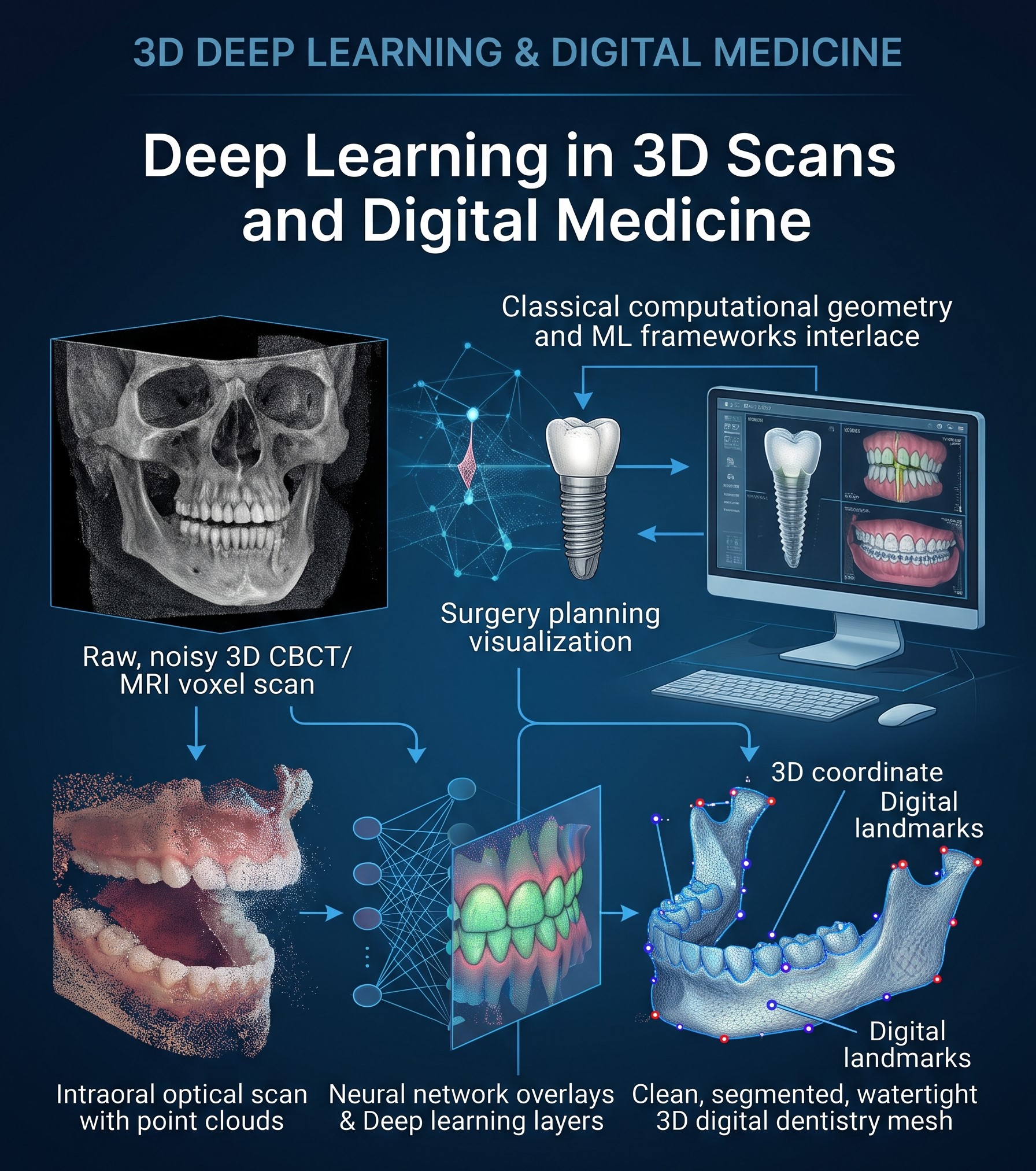
Deep Learning in 3D Scans and Digital Medicine
Beyond accelerating software development, LEDAS engineers use specialized neural networks to resolve the challenging problem of recognizing 3D data, including point clouds and 3D polygonal meshes. These neural networks are applied most notably in our 3D medical software projects, including personalized digital dentistry.
In digital orthodontics, surgery, and orthopedic implant planning, pure classical heuristics struggle with noisy CBCT/MRI voxel volumes and intraoral optical scans. Our teams combine machine learning frameworks with classical computational geometry.
We use ML libraries for teeth segmentation, recognition of anatomical features in DICOM voxel models, for converting this data into clean segmented watertight triangular meshes, and identification/generation of landmarks on 3D meshes. These libraries are also useful for registration, i.e. for global alignment between 3D CBCT volumes and polygonal scans.