AI is becoming an integral part of software development. Successful projects will depend on an effective collaboration between experienced human developers and AI agents.
But what is the right balance between humans and AI?
There is no universal answer.
The optimal approach depends on several factors:
- The type, scale, and complexity of the project
- The availability and expertise of the human development team
- The selection of and appropriate use of AI agents
- The allocation of responsibilities between humans and AI — and the ability to adjust them as the project evolves
- Project management practices adapted to handle Human+AI collaboration
Introducing AI does not automatically reduce development costs or shorten time-to-market.
AI involvement can have the opposite effect: increase costs, create technical problems, delay delivery, and, in some cases, place the entire project at risk.
What do some companies face when they plunge headfirst into AI development?
- The number of completed tasks increases (hooray!)
- The number of bugs fixed increases vs. the number of bugs found grows
- Test coverage becomes more complete vs. the number of tests mushrooms
- The volume of code grows vs. the understanding of the project architecture declines as it is becomes harder to find team members who understand why something was done a certain way
- Duplication of logic is discovered in unexpected places, but there is usually no time to eliminate them, because it is more important to fix bugs and develop new functions
- Each subsequent task requires more tokens and leads to increasingly large code changes; reviewing such changes becomes almost impossible
At some point, the company realizes that the magnitude of the advantages (the first items on the list above) no longer outweighs the disadvantages of uncontrolled infrastructure growth, increasing AI subscription costs, critical delays in time-to-market, and growing security risks. Getting out of this local minimum on your own is not easy.
The challenge is not to simply introduce AI into software development. It is to organize the collaboration between human expertise and AI capabilities in a beneficial way.
This is where LEDAS helps.
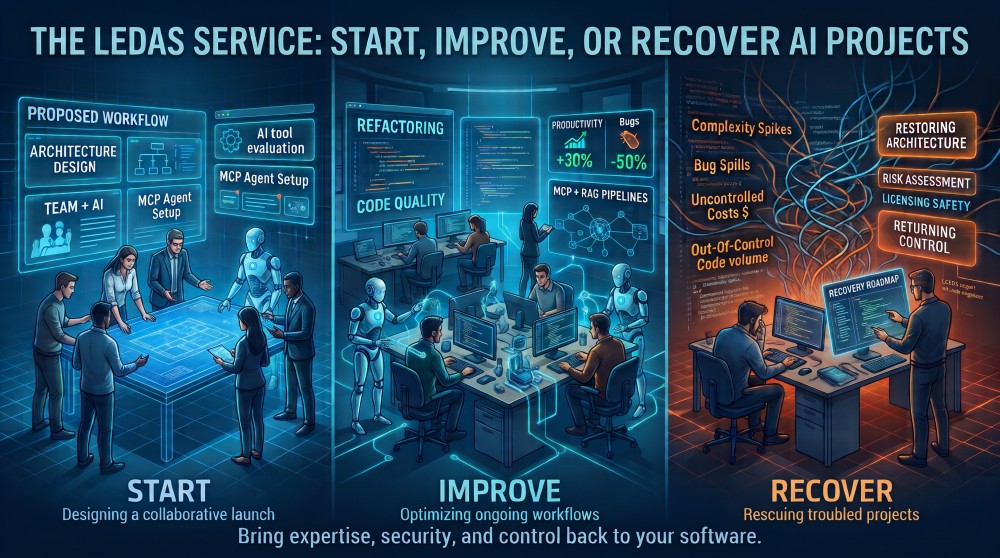
Drawing on its long-standing experience in developing complex custom software projects, LEDAS can help companies plan and launch Human+AI projects, improve projects already underway, and recover projects that have gone offtrack.
Our focus is practical. We know how to make Human+AI collaboration effective, manageable, and aligned with your project’s technical and business objectives.
LEDAS offers hands-on engineering expertise for planning, executing, improving, and recovering AI-powered software development projects.
Our involvement can take these forms:
- Starting a new project by designing an effective development approach; assembling the right team; selecting appropriate AI tools and agents; and establishing clear responsibilities
- Improving an ongoing project by identifying opportunities to improve productivity, quality, and coordination between human developers and AI agents, without unnecessarily disrupting existing teams and processes
- Recovering troubled projects by assessing technical and organizational challenges, developing a practical recovery plan, and taking an active role in implementing it
- Providing expert advice by way of focused technical and organizational assessments, either as an independent consulting engagement or as part of a broader development project
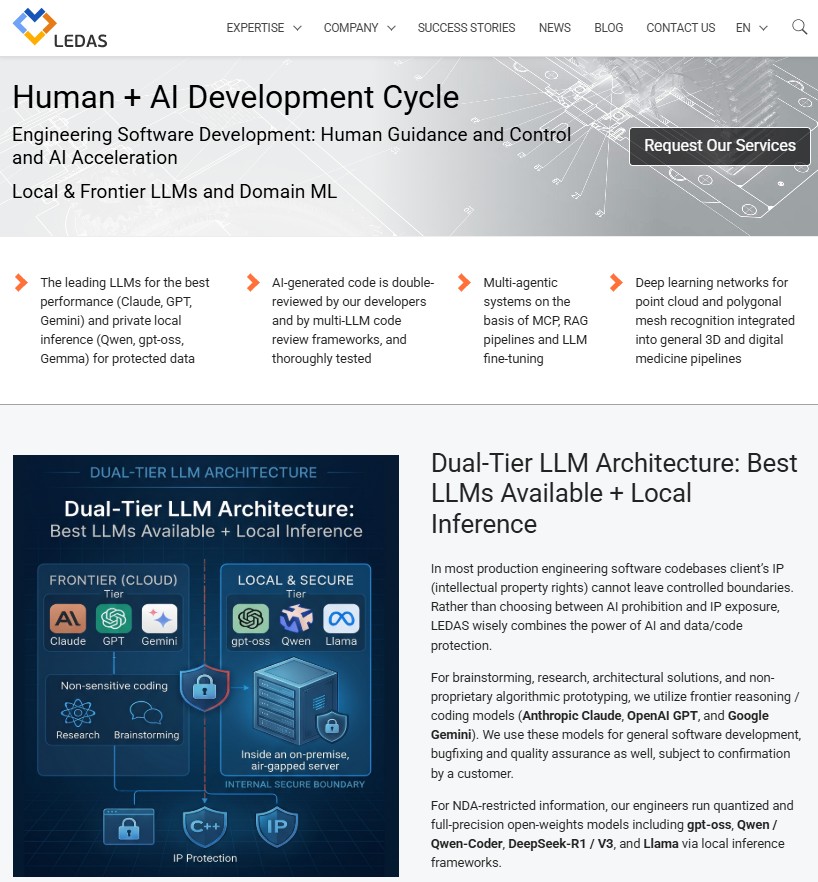
LEDAS has several decades of experience in developing complex software for customers, including projects that required substantial technical improvements, reorganization, and recovery. Our company largely grew out of an early scientific artificial intelligence laboratory, and so we have been thinking about this topic long before the number of today’s articles about AI exceeded the number of atoms in the Universe all reasonable limits. See How LEDAS Uses AI Efficiently and Safely.
As a result, we are today announcing our trilogy: Start-Improve-Recover, with the second and the third parts optional. Our goal is not simply to recommend changes to customers, but to help implement them and then deliver production versions of your software.
We know the effective practices that need to be part of AI-based workflows. At the same time, we see that human architects and leading developers – all with excellent backgrounds in math and computer science – are a must for developing challenging engineering projects successfully.
Write to us at info@ledas.com about your situation. Together we can determine how to best develop your new "Human+AI" projects, or how to regain control of your project.